
The weight of memory
Beloved review

“‘Me and you, we got more yesterday than anybody. We need some kind of tomorrow.’”
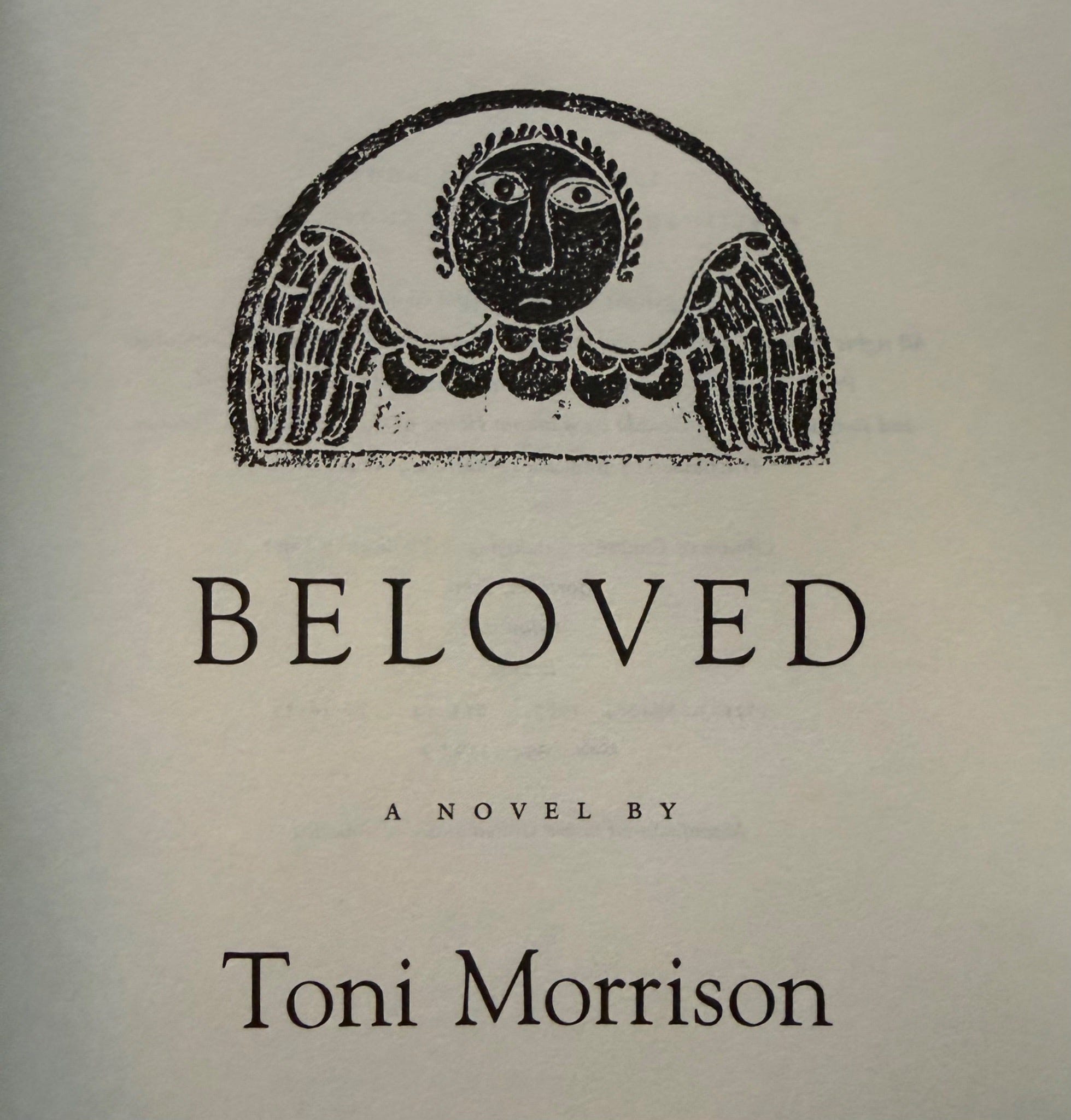
Beloved by Toni Morrison
★★★★☆
When it finally came time to read this Pulitzer Prize-winning work, I felt daunted by the journey ahead of me. Beloved is a frequently banned book, chastised (and praised) for its honest look at slavery and its effects. There’s no arguing that this isn’t a hard read, but it’s an essential one. It’s a story of being haunted by one’s past, and how trauma seeps into our lives long after we’ve experienced it.
To summarize this story in a few sentences feels like a disservice, but here is my best attempt, in case you feel called to read it: the story begins in 1873 Cincinnati, Ohio, where former slave Sethe and her daughter Denver are paid a visit by Paul D, a former slave who Sethe hasn’t seen for almost two decades, when they worked on a plantation in Kentucky together. His presence stirs up buried memories and trauma for Sethe. Nonetheless, the three start to form a life together (despite Denver’s protests), until their lives are upended by the sudden appearance of Beloved, the novel’s eponymous haunting figure.
Morrison shifts between the present day and past events, using third-person omniscient narration to access the memories and perspectives of characters such as Stamp Paid (another former slave), Sethe, Denver, Paul D, and Beloved.
It’s heavy, dark, and lyrical-the nonlinear narrative demanding your persistence-but wow, is it worth it.
Favorite quotes:
“Definitions belong to the definers, not the defined.”
“Freeing yourself was one thing, claiming ownership of that freed self was another.”
“‘Was it hard? I hope she didn’t die hard.’ Sethe shook her head. ‘Soft as cream. Being alive was the hard part.’”
“He knew exactly what she meant: to get to a place where you could love anything you chose—not to need permission for desire—well now, that was freedom.”
“He licked his lips. ‘Well, if you want my opinion-’ ‘I don’t,’ She said. ‘I have my own.’”
“The future was sunset; the past was something to leave behind. And if it didn’t stay behind, well, you might have to stomp it out.”
“. . .anybody white could take your whole self for anything that came to mind. Not just work, kill, or maim you, but dirty you. Dirty you so bad you couldn’t like yourself anymore. Dirty you so bad you forgot who you were and couldn’t think it up. And though she and others lived through and got over it, she could never let it happen to her own. The best thing she was, was her children. Whites might dirty her all right, but not her best thing, her beautiful, magical best thing—the part of her that was clean.”
“‘She is a friend of my mind. She gather me, man. The pieces I am, she gather them and give them back to me in all the right order.’”
“He leans over and takes her hand. With the other he touches her face. ‘You your best thing, Sethe. You are.’ His holding fingers are holding hers.‘Me? Me?’”
“Everybody knew what she was called, but nobody anywhere knew her name. Disremembered and unaccounted for, she cannot be lost because no one is looking for her, and even if they were, how can they call her if they don’t know her name? Although she has claim, she is not claimed.”